

At 3:03 pm on September 11, 2001, 9:03 am in New York, I was in the office at Mediaset, Italy’s largest commercial broadcaster, at its headquarters in Cologno Monzese, on the outskirts of Milan. I was next to the Tgcom newsroom, to be precise. I worked as a product manager, and maintaining the news site was my project. Like every newsroom, we had no shortage of screens, some of them tuned to CNN. That’s where I first heard, then saw, the second plane hit the towers, called over by a colleague running from one room to another to warn everyone of what was happening.
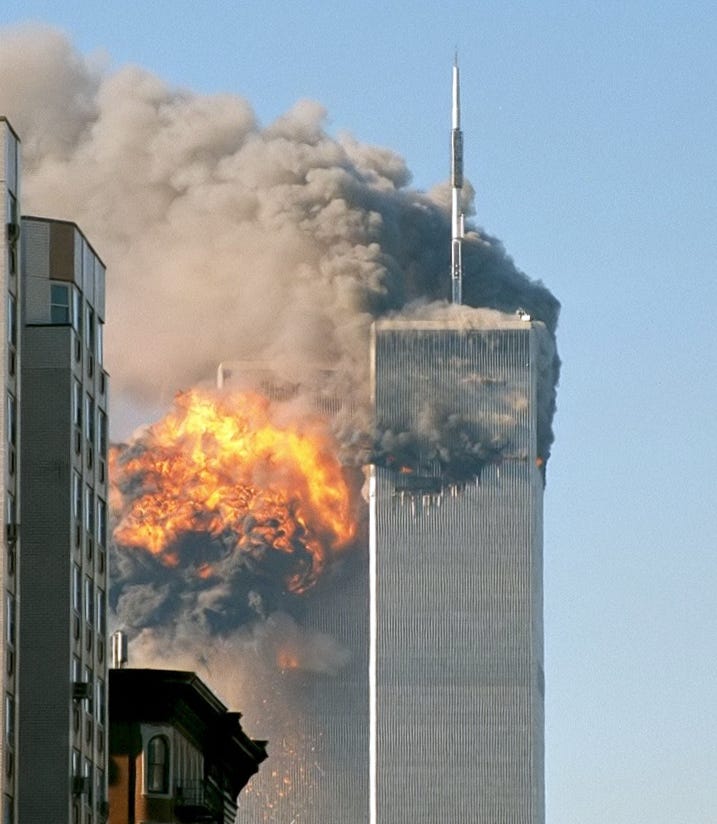

The rest of the day was frantic. Tgcom.it didn’t have a CDN back then, and our pages collapsed almost immediately under the traffic of everyone looking for news: my job, together with the developers, became rewriting the HTML by hand to lighten the pages, to keep them working. We worked at an exhausting pace, and in the meantime some of us, myself included, were shaking. I was convinced that what was starting was a world war. Others thought more cities would be hit within hours. Others still, I won’t hide it, were indifferent.
The news kept piling up: the Pentagon, people jumping from the towers to their deaths, firefighters completely covered in ash, the CNN anchor asking what was happening, "oh my God" the most repeated phrase, a report that was shouted, not spoken. What a contrast, though: the disbelief, the terror, a death that felt too much like a science fiction film not to seem, at moments, almost fascinating, cinematic. And the indifference of those two colleagues, as a counterpoint.
I shook all day, working feverishly to get the site running again, and my heart was pounding, in Milan, as if I too were standing in New York. The rest is history. But it’s also the present.
Twenty-five years ago the world changed architecture. That’s not a figure of speech. After the Towers came the wars in Afghanistan and Iraq, the Patriot Act, airports turned into checkpoints, an entire vocabulary rewritten around two words: security and threat. The order we knew before September 11 never came back, and maybe it wasn’t meant to.
Eighteen days after the Towers, a woman living in New York took the floor in the pages of Corriere della Sera, the country’s leading newspaper, with a piece of writing that would go down in history, Italy’s and the world’s. Oriana Fallaci, to my mind the greatest woman journalist of the twentieth century, the one no world leader dared refuse, hadn’t written in years. It was a very long text, clumsy, furious. It became The Rage and the Pride. It sold over a million copies in Italy and another half a million across the rest of Europe, topping the nonfiction charts in France and Germany, and was translated into at least fourteen other languages.
They called her a racist for that text. Others called her a prophet. Fallaci answered with a line that, read today, still carries its full weight: «silence becomes a fault, and speaking becomes an obligation». In the English version, which she translated herself, she compared Islam to a mountain that, after fourteen centuries, «has never wanted to know about freedom and democracy and progress». Harsh words. Unfair, in part, in their indiscriminate fury. But not harmless, and not useless.
Because twenty-five years later we’re still standing at the same crossroads, except now it has an address: Tiergarten, Berlin. This past July 25th, a van plowed into the crowd at Christopher Street Day. A woman died, dozens were injured. The suspect belonged to the city’s Islamist milieu. In the days that followed, German public debate did what it does best: it carefully distinguished between Islamism and Islam, it remembered Muslim victims of terrorism, it revived Berlin’s day of action against Islamophobia, approved by the Berlin parliament on a joint CDU/SPD motion and observed for the first time this past March 15th. All of it true. All of it fair, in part.
But the distinction, repeated like a formula, has also become a way of not looking the problem in the face. It isn’t only a problem of Islamism, as if it were a virus that could be isolated from the body that carries it. It’s also a problem we have, in Europe, with Islam itself: with its growing politicization, with the networks raising children inside a worldview that treats liberal democracy as an exception to be tolerated, not a value to be shared. In Hamburg, in April 2024, more than a thousand people marched through the streets behind signs reading «Kalifat ist die Lösung», the Islamist Caliphate is the solution.
In Germany today, the party that says this loudest, that we have a problem with Islam, not just Islamism, is the AfD. It says it in the worst possible way, lumping citizens and suspects together into a single racial target. And it’s exactly this short circuit that lets the rest of the political system keep quiet: if telling the truth risks sounding like the AfD, better not to say it at all. So the mother who died at the Tiergarten, her daughter among the twenty-nine injured, the knives of Mannheim and Solingen, the years-long disputes over separate prayer rooms dividing Berlin’s schools, all become collateral damage that open society is simply supposed to learn to live with.
That’s not right, and it should be said without hedging: open society must be defended, not scaled back. But an open society that welcomes anyone who knocks on the door must also post, above that door, the terms on which one enters. Respect isn’t a blank pass. Saying this doesn’t mean hating a billion and a half people. It means no longer using respect as an alibi for silence, and no longer leaving it to those who say it out of hatred to be the only ones who say it.
Fallaci got a lot of things wrong. She didn’t get this one wrong: that silence, sometimes, is a fault.
Oriana Fallaci, 11 September 2001
The book “La Rabbia e l’orgoglio” (The Rage and The Pride) is a timeless classic: you can find it in every language and in every edition. In the Corriere della Sera archive, you’ll find a series of original texts, written at the time and in the years that followed as letters to the newspaper.
«You do not understand, or you do not want to understand, that a religious war is being waged here. Initiated and declared by a fringe element of that religion, perhaps, but a religious war nonetheless. A war they call Jihad. A Holy War. A war that may not aim to conquer our territory, perhaps, but which certainly aims to conquer our souls.
To bring about the demise of our freedom and our civilisation. The annihilation of our way of living and dying, of our way of praying or not praying, of our way of eating and drinking and dressing and enjoying ourselves and keeping ourselves informed. Do you not understand, or do you not wish to understand, that if we do not oppose it, if we do not defend ourselves, if we do not fight back, Jihad will prevail?
(...) Yet the matter is not resolved, nor does it end, with the death of Osama bin Laden. For there are now tens of thousands of Osama bin Ladens, and they are not confined to Afghanistan or other Arab countries. They are everywhere, and the most hardened among them are right here in the West. In our cities, on our streets, in our universities, at the nerve centres of technology. That technology which even the most dim-witted can handle. The Crusade has been underway for some time. And it runs like a Swiss watch.»
(The Rage and The Pride, in Italian, Corriere della Sera, 29/09/2001)