

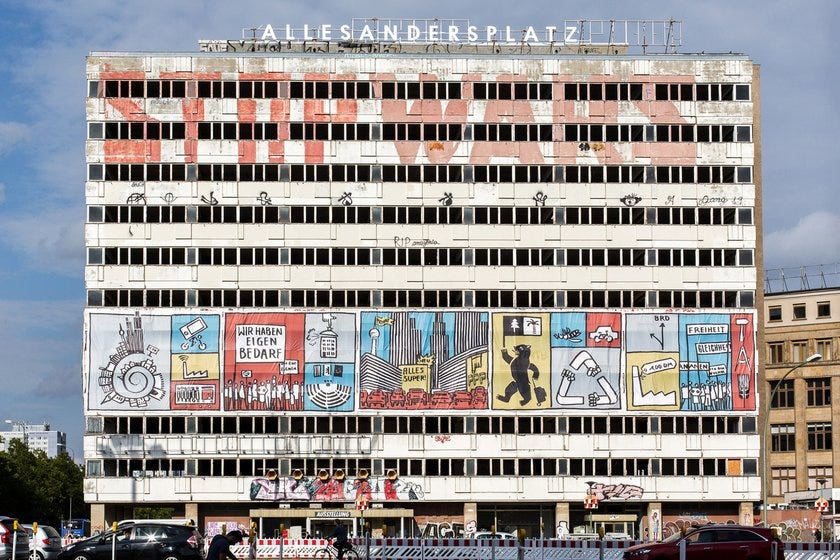
I have known the Haus der Statistik for over twenty years, since my first visits to the city that became my home. The building was huge and seemed abandoned, though a few federal offices were still operating inside. It once housed East Germany’s statistics office. After reunification, it passed to the German Federal Government, which later planned to sell the complex and perhaps demolish it.
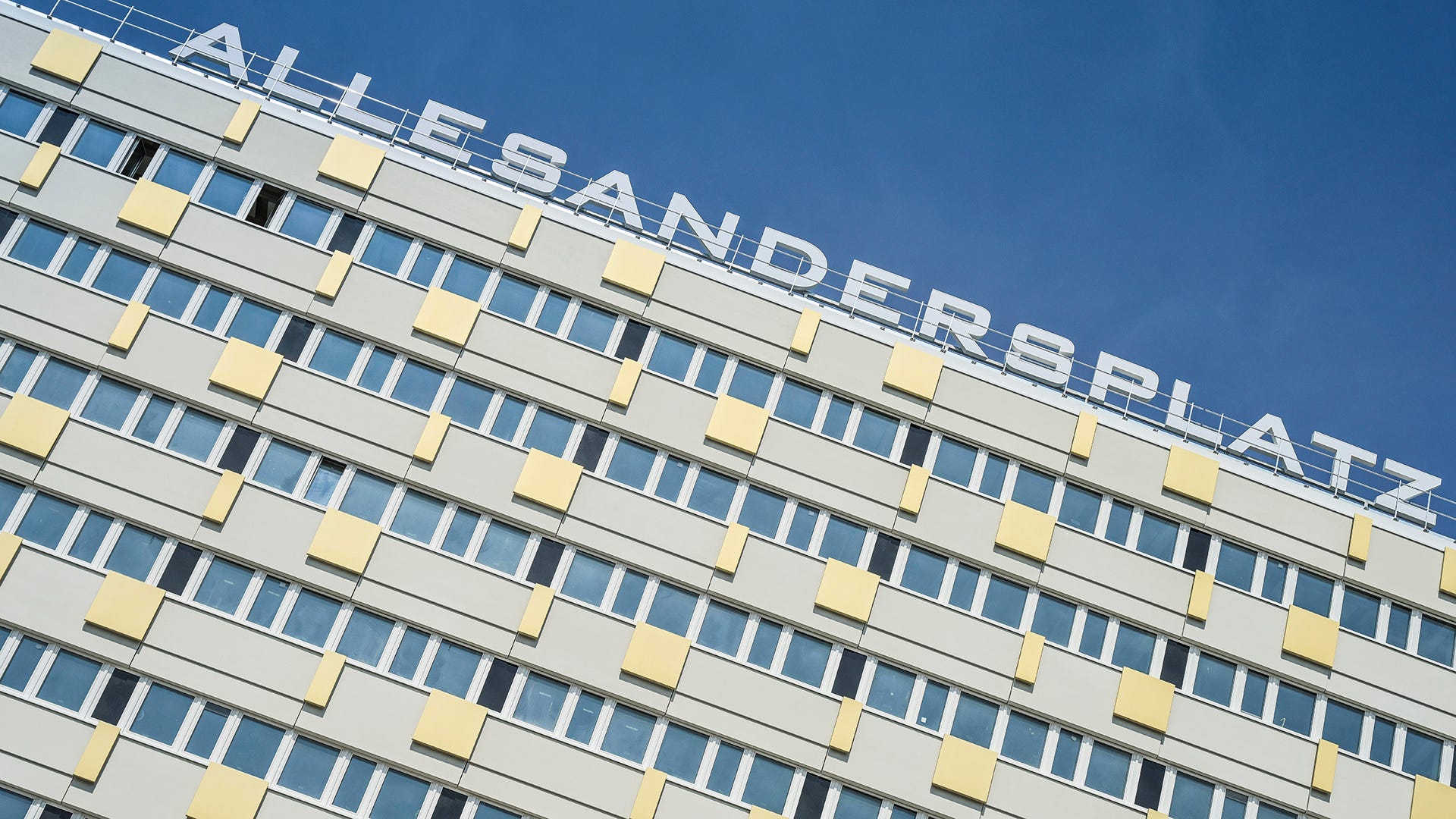
In 2015, the year I moved to Berlin, a group of artists began using it as a space for art, culture, and social life. I lived nearby and watched what followed: the city bought the building in 2017, and took its time before deciding what to do with it. The resident artists wrote a name on the roof: Allesandersplatz: the square that is everything other than what you expect.
The building carries three histories at once: East Germany’s past, the wild years after the Wall, and now, restored and opened to the city, its future.
To discuss the city’s future, the leaders of three political parties met there on Thursday, 1 October. The SPD, Greens and the Left first had to find out whether they could talk at all. Five hours later, they emerged and called it “constructive”: in the coming days, they could start talking.
Berlin is both a city and one of Germany’s 16 states. On 20 September, Berliners elected their parliament, and the Left (“die Linke”) came first with 25.7 percent of the vote. To govern, it needs the Greens and the Social Democrats (SPD).
So, the three parties met again: on Saturday, 3 October, German Unity Day; on Wednesday, 7 October; and on the 8th. These were still preliminary talks before the real negotiations to form a government, and they had only one subject: antisemitism.
Berlin does not yet have a new mayor, but that is not unusual. In Germany, forming a government involves several steps: preliminary talks, exploratory talks, coalition negotiations and a written coalition agreement, usually signed at a formal ceremony. Only then does a government take office.
This time, the process may take even longer: the issues on the table go beyond the usual city concerns. All of Germany is watching Berlin, as are Europe and some countries beyond it. What is being discussed reaches far beyond the city.
From morning to evening, in print, on television and online, the conversation has focused almost entirely on antisemitism, East Germany’s past and the Left’s contacts with organised crime. Missing from the debate is the issue that drove 80% of Berliners to the polls: who owns the city?

Who owns the city?
Before we enter the thicket of antisemitism and Israel, we need to return to what Berliners were asked on 20 September, and what most of them asked for in return: a home they can afford.
In 2016, the average rent in Berlin was about nine euros per square metre. Last year, it was a little over fifteen, an increase of roughly two thirds. Berliners had already voted on this and made their priorities clear.
In September 2021, in a non-binding referendum, about 59 percent of valid votes supported a proposal that the Senate prepare to socialise the large landlords (companies that own more than 3,000 flats). In Berlin, people call this Enteignung, or expropriation. The constitution calls it Vergesellschaftung, or socialisation, a narrower concept than the word might suggest: under Article 15 of the German Basic Law, large property can be transferred into common ownership in return for compensation. In December 2021, the Senate estimated that this would cover about 222,000 flats, roughly one in seven of the city’s rental homes.
Then came five years of back-and-forth: laws written and stalled, expert commissions, and even some government threats to make new laws to prevent Berlin from doing its own… The Left/Linke built its Berlin campaign around one pledge: implement the referendum. It won on that promise.
The potential cost is disputed. The Left says socialisation could be carried out at up to 40 percent below market value, while some economists expect compensation to run into the double-digit billions. Each figure comes from its proponent. How can the city buy back those homes without bankrupting itself?
This is a Berlin story whose roots, like those of many unresolved issues in this city and country, reach back to the years after reunification.
More than twenty years ago, after a banking scandal left Berlin short of money, the city sold many of the flats it is now being asked to buy back. In 1990, the city’s housing companies held about 480,000 flats. Fifteen years later, they held about 270,000. In 2004, the Berliner Senate—then governed by a coalition of the Social Democrats and the PDS, the party that later became the Left/Linke—sold about 65,000 flats for 405 million euros. The two buyers, American investment firms, also took on about 1.5 billion euros in debt, effectively saving the city from potential insolvency. A 2016 documentary gave this story its name: Die Stadt als Beute (The City as Prey).
The Left later reversed course, backing the referendum and the buybacks. The party now proposing to take the flats back is the same party that, in an earlier form, sold them.
That alone could fuel endless debate. Yet the debate that has kept us stuck for weeks is different. It is no longer about who owns the city, but about who does what in the Middle East.
Two Lefts and Israel, in Berlin
This story does not begin on October 7. The tensions between the German left and Israel reach deep into the histories of both East and West Germany. Woven through them are older forms of antisemitism that never disappeared on either side of the Wall.
Today’s Linke is the daughter of two lefts: when it was formed in 2007, it brought together parties rooted on opposite sides of the Wall. The PDS was the successor to the party that had ruled East Germany; the WASG was a splinter party based mainly in the West. Each arrived with its own history with Israel.
In the West, part of the left turned against Israel after the Six-Day War of 1967, with anti-Zionism shading, in some circles, into open antisemitism. Behind this shift lay the Cold War. Having backed the creation of Israel in 1947, the Soviet Union had turned towards the Arab states in the mid-1950s, making the Middle East a front in its struggle against Western influence. After 1967, Soviet propaganda cast Israel as an imperialist state, a weapon of American imperialism. That language found its way into West German universities and, from there, into West Berlin.
On 9 November 1969, the anniversary of the 1938 pogrom, a bomb was left in the Jewish Community Centre in West Berlin during a commemoration. It did not explode. But it left a permanent mark on the city.
East Germany took another road. It never had diplomatic relations with Israel. Its ruling socialist party refused reparations, arguing that expropriating the capitalists was the best reparation imaginable. Many of the country’s Jews were committed communists who had returned from exile to help build an antifascist state. Yet repression and anti-Zionist propaganda marked their daily lives. Most stayed nonetheless, maintaining a cultural life of their own in East Berlin.
The state’s ties with the PLO followed a different course: its mission in East Berlin became an embassy in 1982, and East Germany recognised the state of Palestine in 1988.
Only in its final months did East Germany confront this history. On 12 April 1990, its first freely elected parliament, acting on a motion supported by all its parliamentary groups, asked the Jews of the world and the people of Israel for forgiveness. It acknowledged the hypocrisy and hostility of official policy towards Israel, and the persecution and humiliation of Jewish citizens. The new government’s coalition agreement set out to establish diplomatic relations with Israel. Before that could happen, the state itself ceased to exist.
Four years after the Linke’s foundation, a draft of its 2011 programme committed the party to Israel’s right to exist and to a two-state solution.
Those commitments did not settle the argument over antisemitism. At the party’s congress in Chemnitz in May 2025, a narrow majority of delegates backed the Jerusalem Declaration on Antisemitism, which defines the term more narrowly than the definition most widely used in Germany. The debate over Gaza brought another turning point. At its Potsdam congress on 19 June 2026, the party decided for the first time to describe Israel’s conduct in the war as genocide. The resolution also rejected Hamas as an Islamist terror organisation, affirmed the right of both Israel and Palestine to exist and demanded a halt to arms deliveries to Israel. It named no definition of antisemitism. A separate decision called on the executive to engage with Jewish organisations. At the level of official policy, all of this is legitimate.
Yet inside the party, there is unease. It was already evident in August 2025, when several members campaigning against antisemitism in their regional branches wrote to the national executive.
Their request was clear: the Linke should distance itself from antisemitic slogans at anti-Israel protests, both in Berlin and beyond. Criticism of Israel’s military conduct was legitimate, they wrote. Solidarity with Palestinians must not mean tolerating chants of “Intifada” and “Death to Israel”.
Beyond the official declarations, then, lies a pronounced hostility to Israel, partly inherited from the distant past.
On Berlin’s streets, that hostility has more often than not become open antisemitism. Between the party’s written commitments and what the city has witnessed, a gap remains. During Berlin’s election rallies, it became impossible to ignore: rappers performed lines such as “Yalla Yalla Intifada, West Bank, Palestine, Gaza”, while audiences shouted “Death to the IDF”, the Israeli army.
That leaves the party exposed to criticism from other parties and the media.
For the conservative CDU, the biggest loser of this election, the accusation of antisemitism is a way to keep the Left out of the mayor’s office. It seeks to erect a moral firewall like the one the mainstream parties still maintain - or do they? - against the far-right AfD. Even Chancellor Merz entered the argument on 7 October, urging the centrist parties to use their existing majority to prevent a Left mayor in Berlin. But Merz no longer controls either his government or his party.
The ghosts of Berlin
Since the vote, Berlin has become a meeting place for the ghosts that have haunted Germany for years. There is antisemitism, old and new; the East, a region said never to have fully embraced liberal democracy; and the Brandmauer, the firewall: the mainstream parties’ refusal to work with the AfD.
In recent weeks and months, these ghosts have taken on substance.
The ghost of anti-semitism is harder to dismiss when set against the events themselves: antisemitic remarks by individual officials in an internal forum of the Left’s youth organisation, leaked to the media; election-night scenes at the Left’s Neukölln branch, where an activist said to be close to the Popular Front for the Liberation of Palestine, listed by the EU as a terrorist organisation, was cheered as a guest; a representative of Berlin’s Arab family clans that control parts of the city’s criminal business. Then came the departure of the Left’s federal deputy from Neukölln from the Bundestag’s interior committee, after chats with the son of a arabic clan head became public.
The ghost of East Germany, the former GDR, is much easier to dismiss, at least when you look at those who lead the Berlin Left today. Its lead candidate was born in Munich in 1981 and grew up in Dortmund and Hamburg. Both state chairs were born in the East, but one was born in 1986 and was only three when the Wall fell; the other was born in East Berlin in August 1990. It takes quite a stretch of the imagination to describe them as the heirs of Erich Honecker.
The last ghost is the firewall, the Brandmauer: the most-used political word in contemporary Germany, repeated so often that it has lost its force.
Yet this ghost may soon fade. Voices in the CDU are beginning to call for an end to the debate. Behind closed doors, I hear, some fear this could become a strategy: once the Left takes the reins in Berlin and the barrier against it falls, the CDU’s most conservative wing may have a chance to bring down the other barrier too: the one against the right.
Zoom out, zoom in: Berlin’s new political map
From above, a different picture of the city emerges. Berlin’s old East–West divide has faded, but new walls have risen within both halves.
A Tagesspiegel data analysis found that, since 2021, the gap between voters inside and outside the S-Bahn ring—the city’s circular railway, known for its red-and-yellow trains—has been wider than the gap between East and West. The ring has become the new wall, so to speak. But the picture is more complex once you zoom in on the map.
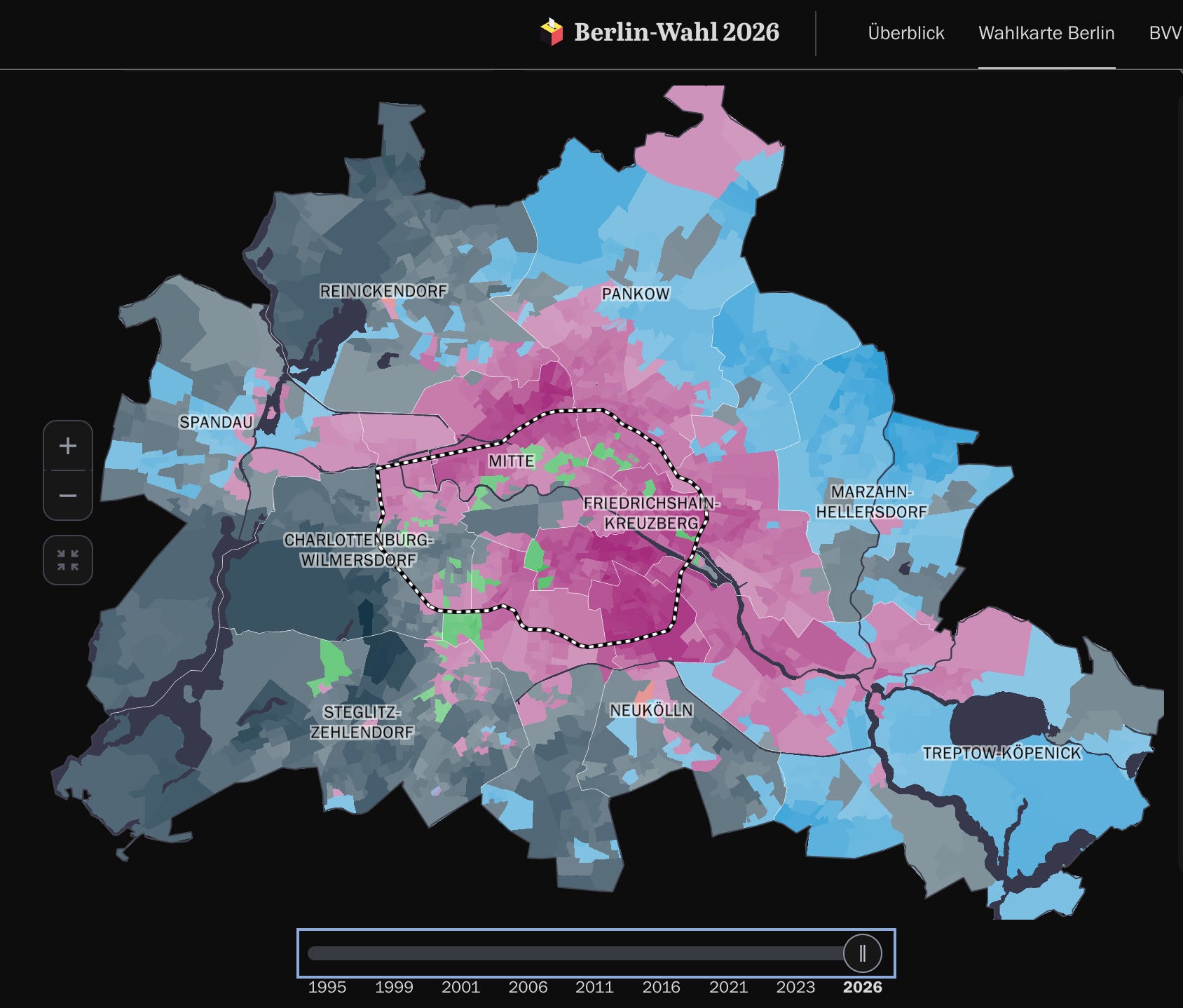
Neukölln sits at the intersection of old and new walls. The whole borough was in West Berlin, with the Wall running along its edge: there was a border crossing on Sonnenallee, and to the south the Wall separated Rudow from East Berlin’s Altglienicke. Today, another divide runs through the borough. In the north and centre, among the scene and the Kieze, as Berliners call their neighbourhoods, the Left has displaced the Greens. In the south, among the detached houses of Britz, Buckow and Rudow, and the social-housing estate of Gropiusstadt, the CDU and AfD have displaced the Social Democrats.
The farther east you go, the stronger the AfD becomes. It is the strongest party in Marzahn-Hellersdorf, on the city’s eastern edge, and in Köpenick. Many residents of these districts grew up in the GDR.
To the west, the CDU remains strongest in the four outer districts of Steglitz-Zehlendorf, Spandau, Reinickendorf and Charlottenburg-Wilmersdorf, though it has lost ground. Even here, the AfD is beginning to establish footholds, including in Spandau.
Prenzlauer Berg, where I live, was known across Germany until five years ago as the Latte-Macchiato district and the country’s green stronghold—an island in a city that is itself an island in the former GDR. Now green has turned red.
Zoom in on the streets where I live, at the edge of Prenzlauer Berg. New buildings stand beside older ones, refurbished social housing and the GDR’s prefabricated blocks, the Plattenbauten. Within a few hundred metres, the scale of the transformation—and its surprises—comes into view. In my blocks, where younger, mostly educated newcomers to Berlin live, green has given way to the dark red Linke.
Cross the square, pass the supermarkets and a small neighbourhood mall, and you reach a large, well-renovated complex of Plattenbauten. East Germans who have lived here for decades share it with Vietnamese and other migrants who arrived in GDR times. Until 2021, these blocks were an SPD stronghold. Now the AfD is the leading party there.
Walk east to the beer garden where I like to sit, or jog beside little Weißensee, and the map starts to turn blue like AfD. Farther north, the contrast sharpens: Pankow is one district with two political climates, the AfD and CDU strong in the north, the Greens and Left in the densely populated south.
Is this simply about age? The Left won close to half the vote among under-35s, but ranked behind the CDU, SPD and AfD among voters over 60. The AfD, meanwhile, is no party of the young: it does best among people aged 45 to 69, workers, and those with less formal education—the voters the Left once counted among its own.
Does migration background also matter? Until few years ago, long-term residents and newcomers still voted in opposite ways: long-term residents backed the CDU, while newcomers backed the Greens.
Berlin’s 2026 electoral map is more complex. It reflects not just a generational divide but several overlapping ones: age, education, income, and length of residence. The more you try to apply stereotypes, the less you understand what has been happening here. Many international journalists have failed to read the city.
This, too, is a very Berliner story: are you old enough to remember that, in 1989, most journalists were sure the Wall would not fall for years?
Today, tomorrow
Between 20 September and 10 October, Berlin lived through two Octobers. German Unity Day fell on the third, increasingly a day of reckoning. On the seventh, the Israeli flag was projected onto the Brandenburg Gate. At Bebelplatz, where books burned in 1933, the city commemorated the 2023 massacre. An official ceremony took place that afternoon, followed by a more emotional, grassroots vigil that evening. Almost simultaneously in Kreuzberg, a march chanted slogans glorifying “the resistance.” A poster showed the bulldozer that breached Gaza’s fence, recast as a new icon of the intifada.
Meanwhile, talks continued here at Haus der Statistik. On the eighth, they gave way to the real negotiations: the ones that might finally shape decisions for Berlin and life here and now. But not everyone was pleased.
On Saturday, 10 October, a pro-Palestinian march reached Alexanderplatz. Police counted around 3,000 people. The marchers shouted, “Free Palestine, free Palestine” and “Fuck you, Israel.” Thirty-seven years earlier, on 7 October 1989, around 3,000 Berliners had marched from the same square to the Palace of the Republic, where the GDR was celebrating its fortieth anniversary with Mikhail Gorbachev as guest of honour. They had shouted, “No violence,” “We are the people,” and “Gorbi, help!” Three thousand then; three thousand now.
This is Alexanderplatz. This is Berlin: a square, and a city, that is never quite what you expect - Allesandersplatz - and where the unexpected can set events in motion, perhaps reshaping not only Berlin but Germany and Europe.
Yes interesting. Do you have ideas on good sources to investigate the debate of financial insecurity and loss of culture vs. Inability and unwillingness to adopt to democracy and capitalism to explain the AFD success in the East? Is it unfathomable in the here and now to explain or is it depending upon the biases of the scholar?
A thoughtful assessment. Thank you Valentina.