

Twenty minutes. That’s how long the local train takes to run, on Poland’s Baltic coast, from one end of the country’s most complicated century to the other. Together, the three cities it connects are called Trójmiasto, the Tri-City. Gdańsk, the ancient one, is a thousand years old: today a tourist magnet, visited all year round but especially in summer, enchanting visitors with its Hanseatic brick architecture, completely rebuilt after the war with devotion to the smallest details. Sopot, the sea resort, is all Art Nouveau villas and an elegant pier. And then, a few minutes further north, Gdynia: the youngest of the three, and the strangest, a fishing village of twelve hundred people that became, within a generation, Poland’s window onto the world.
The story I tell today starts from a corner of this city, on a not so warm summer day of 2026. Here, the small village and the ambitious city still stand face to face, and with them, two centuries.
On one side: a small house with a corner turret, built around 1912, when this was still a fishing village. It belonged to Jan Radtke, the village’s first Polish administrator, a man whose job title, sołtys, belonged to a world of nets and herring and a handful of families who knew each other by name.
On the other side, close enough to stay in the same camera picture: a blocky modernist tenement from 1927, home in its day to the Grand Cafe. Marble tables, waiters in white, the most fashionable address on the coast.
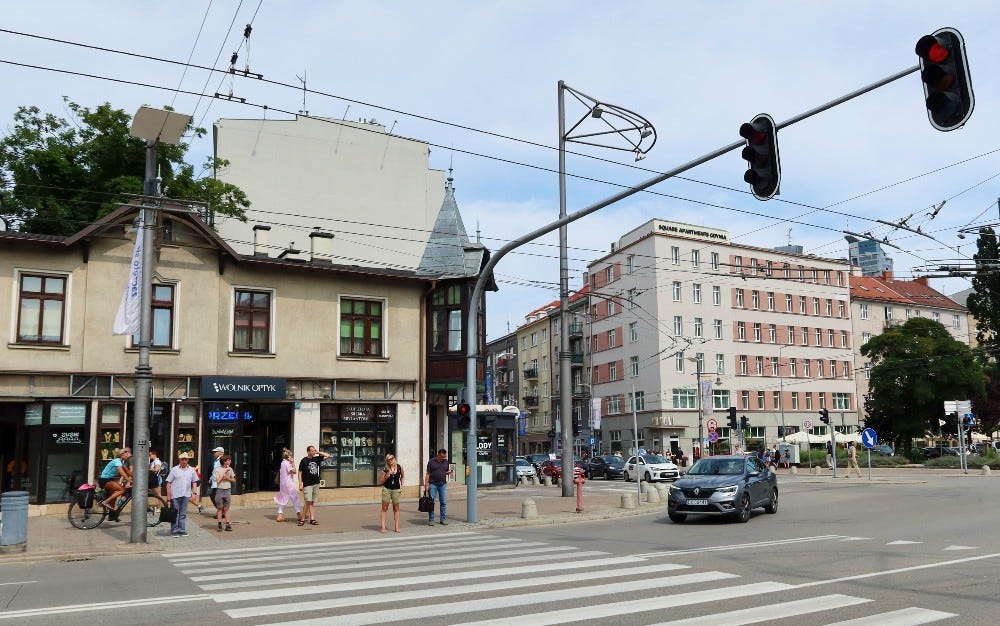
Fifteen years separate them. Fifteen years, and an entire idea of a country.
Gdynia was born from a single, stubborn conviction: that a nation without a coastline of its own is not fully a nation. After the First World War, Poland had just been stitched back together after a hundred and twenty-three years of partition: carved up, in 1795, between Prussia, Russia and Austria, and erased from the map for over a century. In 1918, it came back. In 1920, the Treaty of Versailles gave it a strip of Baltic coast, a hundred and forty kilometres long, but not Danzig, the one real port on it, which became a Free City under League of Nations protection, out of Polish hands. What Poland got instead was a narrow strip of land that history would come to know as the Polish Corridor.
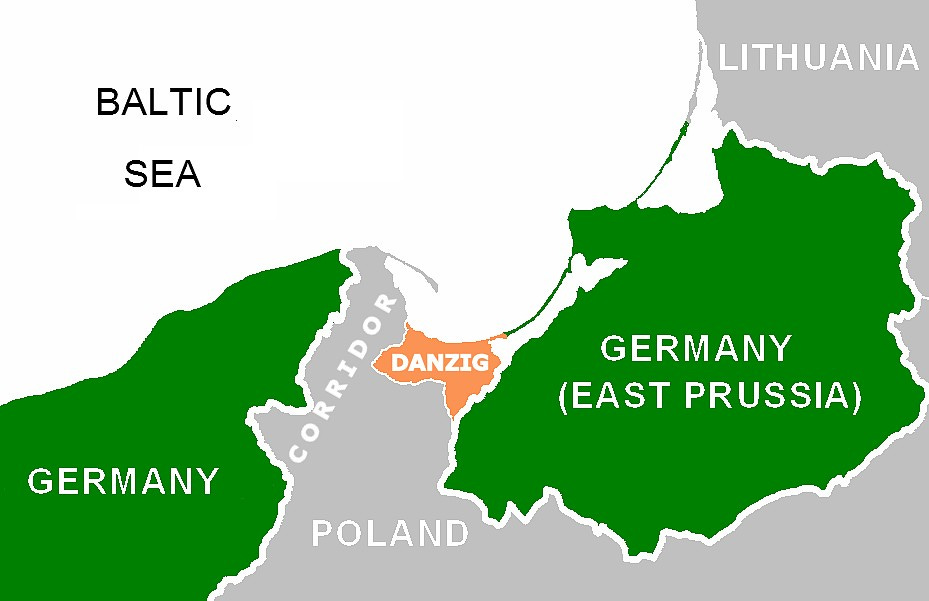
So Poland had to build its own port from nothing. And from a port, a city was born in just a few years, like a film running in fast motion: pushed forward by economic ambition, by military need, and by dreams that would become the most famous modernist architecture in Central and Eastern Europe. To this day, this is the tagline the Poles still give it: Miasto z morza i marzeń. The city of sea and dreams.
Welcome to Gdynia.

1926–1930: building a city from nothing
The decree declaring Gdynia a city came on the tenth of February, 1926. The date was chosen to honor the sixth anniversary, to the day, of the zaślubiny Polski z morzem, Poland’s symbolic wedding to the sea: a ceremony held six years before, at Puck, when Polish General Józef Haller, inspired by an old Venetian tradition, threw a ring into the Baltic to seal the nation’s return to its coast.
“Poland without its own sea coast and without its own fleet,” said Eugeniusz Kwiatkowski, the engineer turned Minister of Industry and Trade who would become the project’s political engine, “will never be united, nor independent, economically or politically, nor respected in the great family of nations.”
In 1926, the city was such only on paper. Four years later, more than thirty thousand lived in Gdynia. By 1939, over a hundred and twenty thousand had made Gdynia their city: people arrived faster than streets could be paved for them.
And it was in these years, the late 1920s, that modernism arrived too, in a land that was a perfect empty canvas: no home style, no legacy to respect, only a future to invent. Architects came to Gdynia in two temperaments: the moderate wing, drawing on Art Deco and a softened classicism, and the avant-garde wing, pure functionalism, cubic and unapologetic. Both called themselves modern. Both were, in their own way, arguing for the same thing: that Poland, reborn, deserved its own architecture, world-class and owing nothing to the older empires.
One neighbourhood makes the ambition visible before a single office complex is built. Kamienna Góra, planned from 1920 as a garden suburb for the city’s professional class on the slopes of the hill it takes its name from, drew on the garden city model that the English planner Ebenezer Howard had proposed a generation earlier: self-contained communities wrapped in greenery, homes with gardens rather than the airless tenements of the industrial city, a middle way between the crowding of the town and the isolation of the countryside.
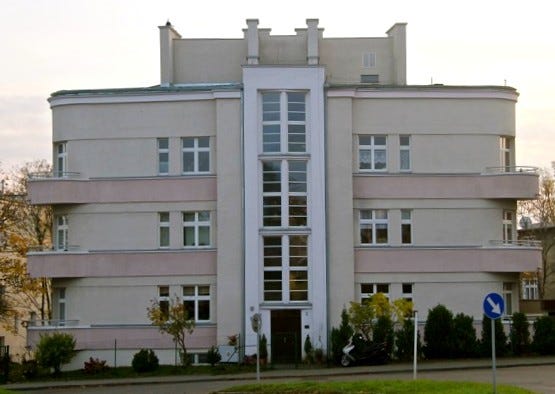
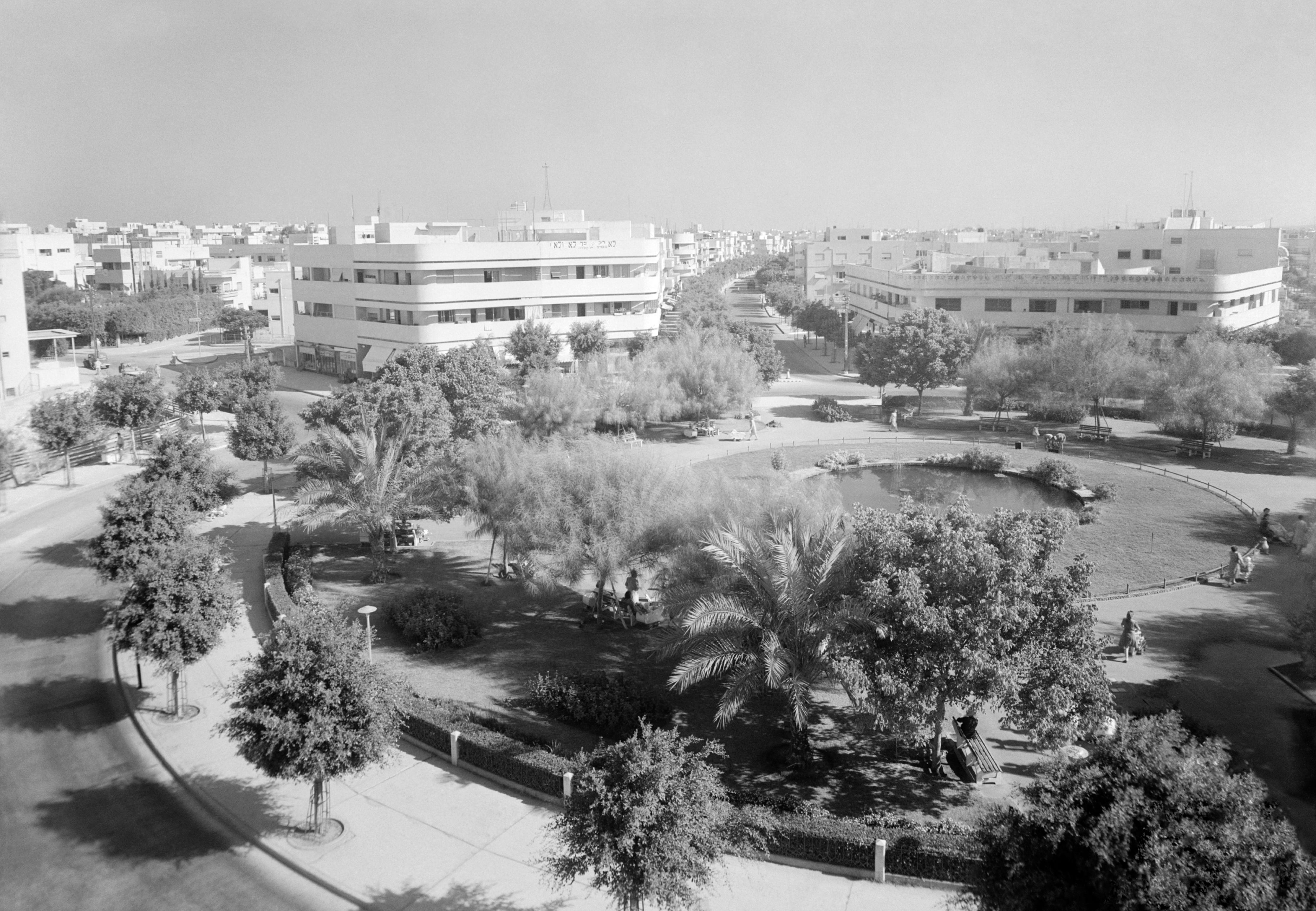
That modernist, humanistic current ran also through Germany. A young man born in Jarosław, then Austria-Hungary and now Poland, left for Palestine, took the name Arieh Sharon, then came to Germany to study at the Bauhaus in Dessau and work in Berlin until 1931, before leaving again to help build one of the defining cities of another new coast: Tel Aviv. Weimar Germany, reborn Poland, and a Jewish homeland still taking shape in Palestine were, without knowing it, drawing from the same well.
Toward the sea, facade after facade
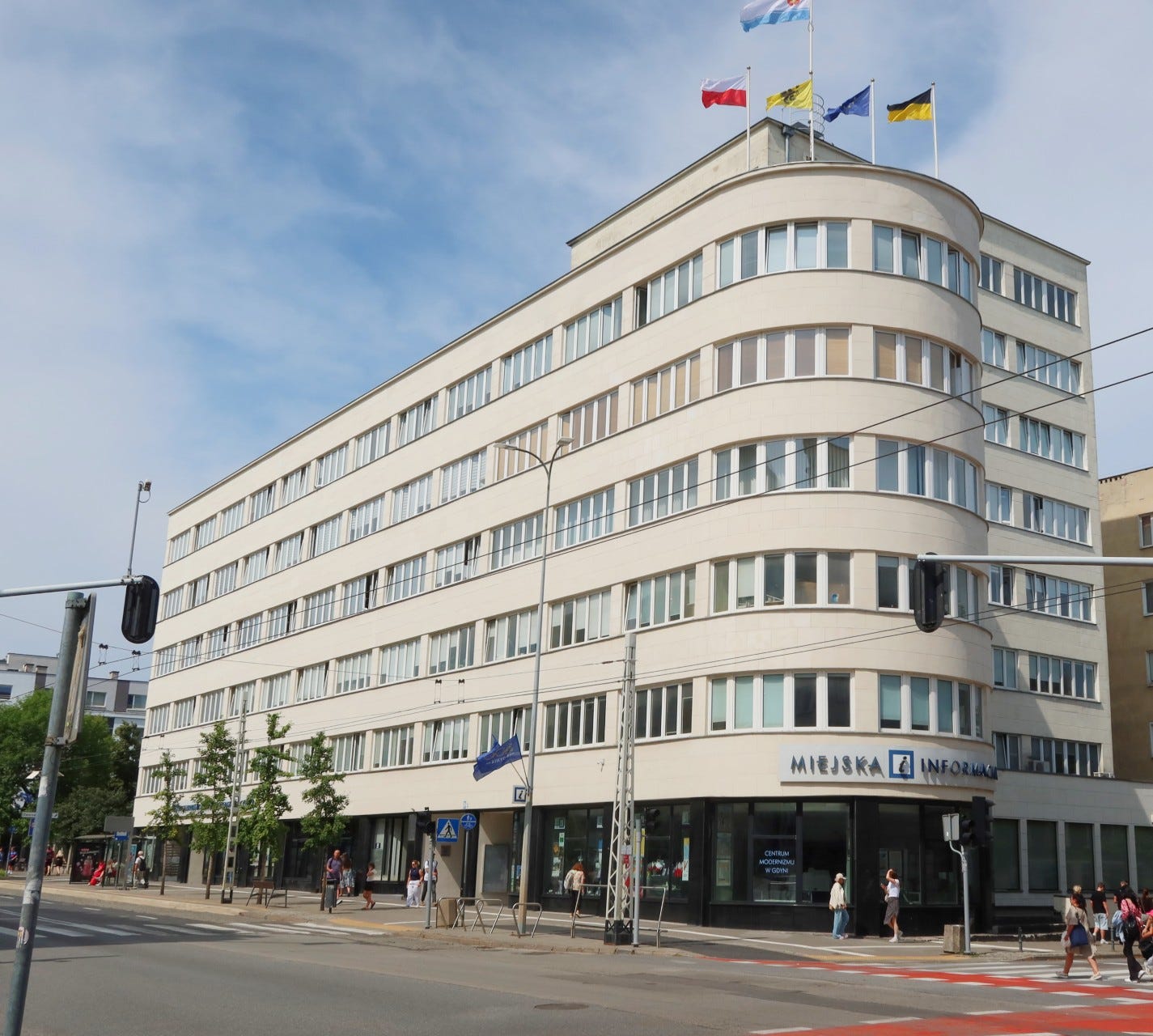
Walk down 10 Lutego Street today, the city's main artery, running in a straight line from the railway station to the sea, and the city tells its own history in facades. At number 24, a building with a rounded corner sheathed in pale limestone over black granite steps out toward the intersection like the prow of a ship: this was the headquarters of the Social Insurance Institution, finished in 1936, later, under communism, the headquarters of the state shipping company Polish Ocean Lines.
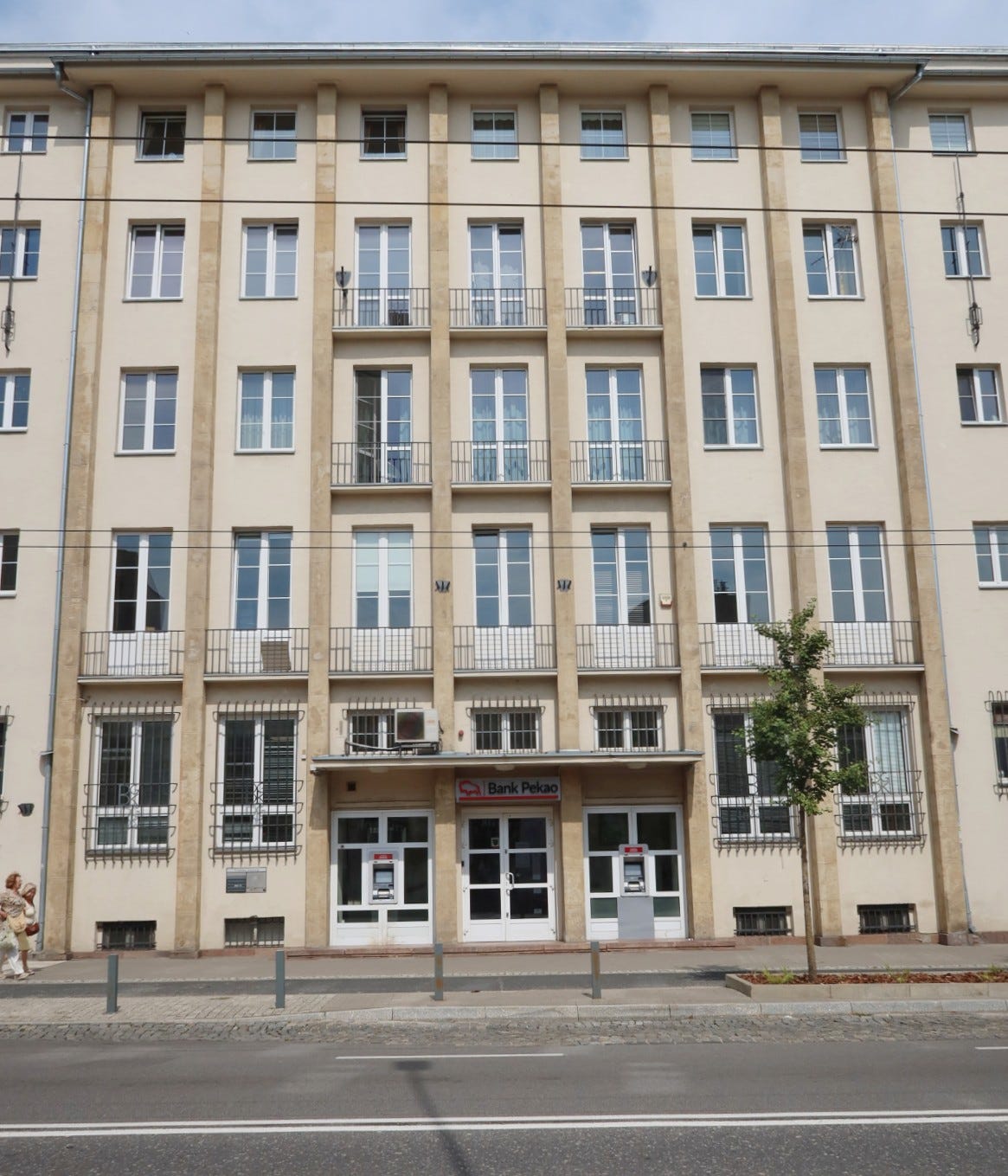
A few doors down, at number 8, a different temperament altogether: thin stone pilasters running the full height of the building, moderate modernism, classical bones dressed in a new language.
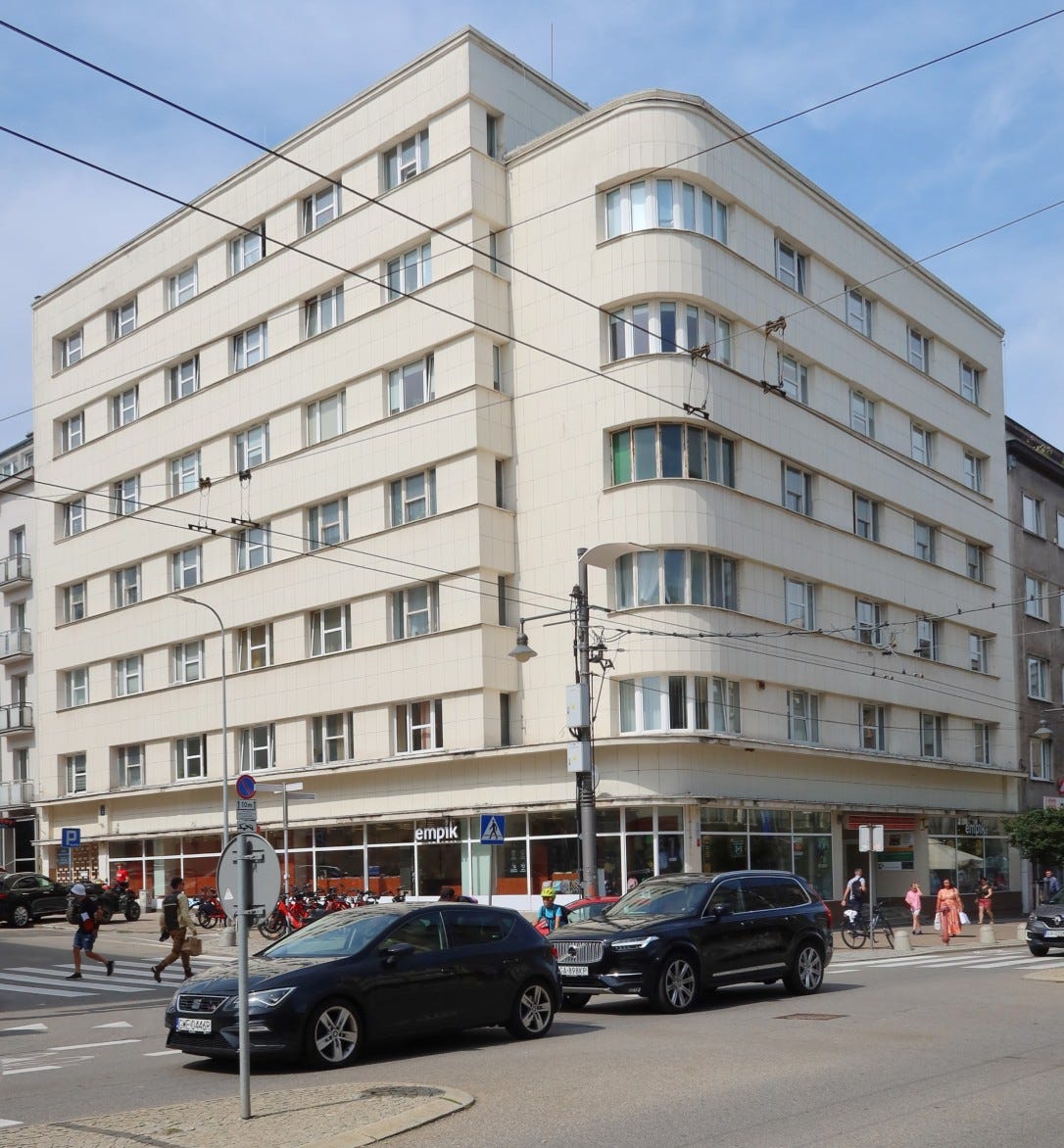
Turn the corner onto 3 Maja and the Bankowiec building waits, curved glass ribbon windows wrapping a rounded corner that steps down with the slope of the street itself. Built as housing for bank employees, it remains one of the finest examples of Gdynia's interwar functionalism.
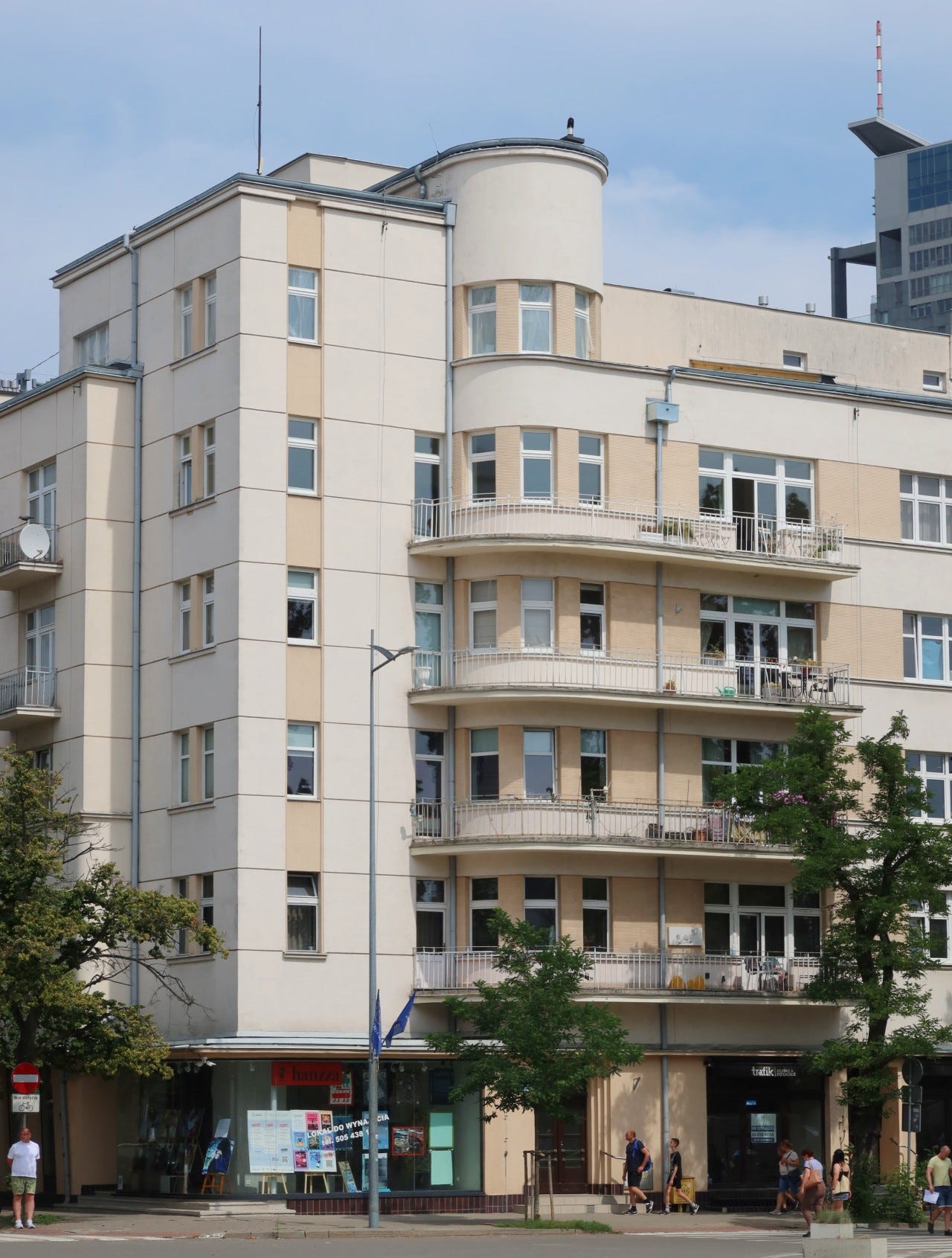
Walking toward the sea, the buildings begin to take on shapes that recall the deck of a ship. Nowhere is the metaphor more visible than by the Pręczkowski tenement, which rises with a cylindrical turret and rounded balconies. Built in stages between 1928 and 1937, it is still considered the single most spectacular modernist building Gdynia produced in its first decade.
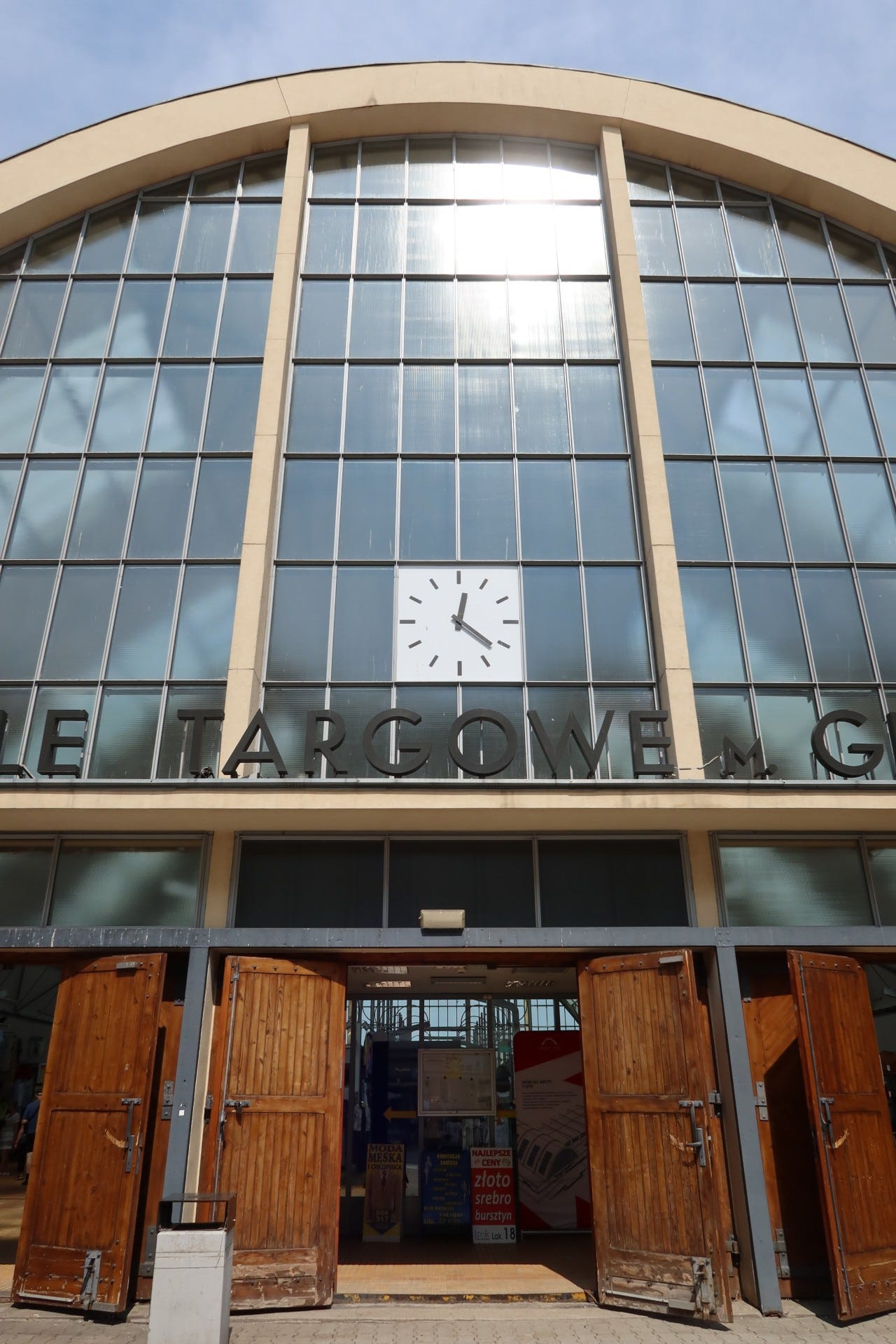
But a city is not only its facades. It is also its plumbing, its market halls, its railway, its port. The Hala Targowa, a covered market hall raised between 1935 and 1938 on a lightweight steel-ribbed roof flooded with glass, is not so different from the market halls one still finds in Berlin or elsewhere across Europe: glass, brick and steel, monuments to the turn-of-the-century idea that a growing city needed to feed itself in style.
Gdynia Główna train station, rebuilt after the war, trades the city's white modernism for something heavier: high panelled halls, monumental proportions, socialist realism dressed in classical detail. Inside, mosaics from 1957 still cover the walls of the main hall: a seascape, a shipyard, Pegasus riding the wheel of the state railway company, uncovered during a restoration only completed in 2012.


Then, the port: military and commercial at the same time. It was here that the young Polish Navy took shape alongside the merchant fleet: destroyers, minesweepers, a handful of proud, undersized ships meant to guard a coastline the nation had only just reclaimed. One of them was called Wicher, Polish for a strong, howling wind, built not here but in France, commissioned in July 1930, and sailed to Gdynia a week later as the young navy's first modern ship. Its story does not end in the 1930s. It comes back, much later, at the far end of this essay.
Gdynia-Tel Aviv, Poland-Palestine, and return
By 1937, roughly five thousand Jews lived among Gdynia’s hundred thousand residents, a small fraction of the city’s population but a constant presence in its story. For many of them, and others coming from the rest of the country, Gdynia became in the 1920s a way station, the last Polish ground under their feet before a ship carried them somewhere else: in most cases, to Palestine.
Interwar Poland held every shade of Zionism a movement can hold: labour Zionists organizing kibbutzim before they had ever seen one, religious Zionists reading Palestine as prophecy fulfilled, revisionists impatient with waiting for permission from anyone. What they shared was a port. Gdynia’s own shipping line ran a service to the Levant from 1935, the same year Polish passenger ships began calling regularly at Haifa and Jaffa. In 1933, the Polish state bank, PKO, opened a branch in Tel Aviv, a small building for a very large idea: that money, like people, could now move directly between the two new cities without passing through anyone else’s territory first.
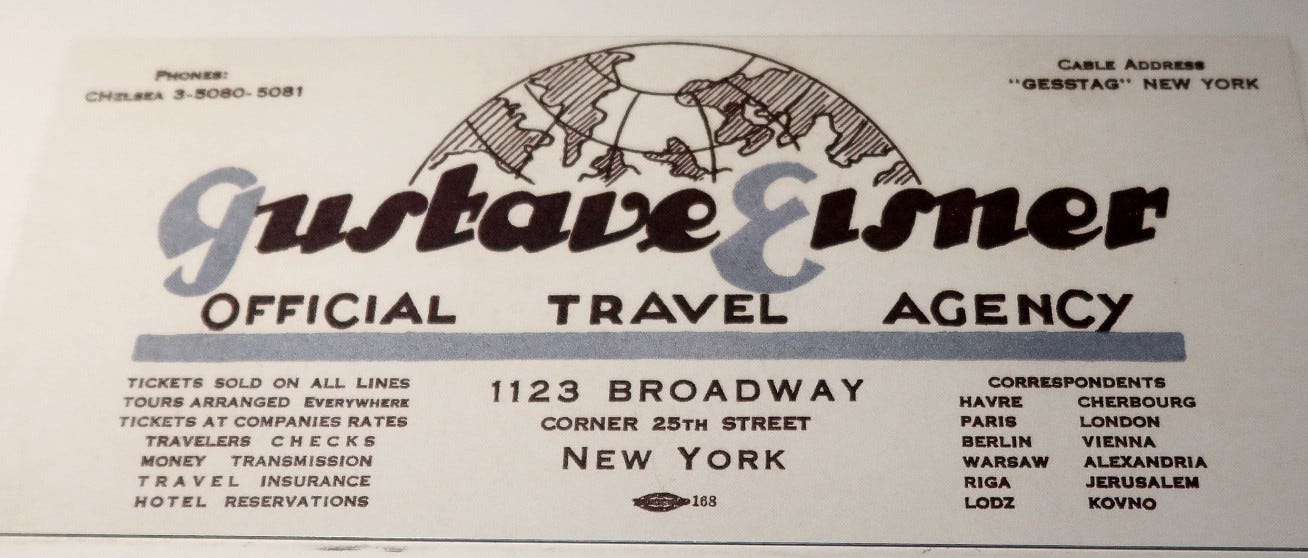
None of this ran on shipping lines alone. In New York, an agency on Broadway run by a man named Gustave Eisner specialized in exactly this kind of distance: tickets, wired money, paperwork, and a network of correspondents in Warsaw, Gdynia, and Łódź who could track down a relative, confirm a passage, or send a remittance home. Agencies like his were the invisible infrastructure behind every emigration story, the desks where a decision made at a kitchen table in Poland became a booked cabin on a ship out of Gdynia.
In the collection of the POLIN Museum in Warsaw hangs a banner, its message written three times, in Yiddish, Polish, and English, describing a Friday-evening gathering its group called a Kestl-Ovnt, a box evening. Beside it, a young woman’s own words are recorded:
There is no life for us in Poland... I want to go to Palestine... I will try to save the money for the trip. When my cousin gets the certificate, he will add my name, and being in Palestine, I’ll try to bring my parents there. Will the plan materialize?
Gina was twenty-three.
Many like her did leave. Many more never got the chance. Only a few, exceptionally, made the journey back. Czesław Zdeb, born in 1923 near Miechów, in southern Poland, finished his secondary education not in Poland but in Tel Aviv, where he had gone as a teenager, likely sailing from Gdynia itself. From there he enlisted at Haifa in February 1941, fought with the Carpathian Rifle Brigade, a Polish unit under British command, at Tobruk, trained as a pilot in Britain, and flew, decorated, until the war ended. When it was over, he came home the same way so many had left: through the sea. His repatriation papers show him registering at the reception point at Gdynia Port on the tenth of June, 1948, bound for Kraków.
The human cost of utopias
The city of sea and dreams, but not for all. White cities, it turns out, tend to have darker backgrounds.
By the mid-1930s, the same boom that filled Kamienna Góra with the city’s professional class and filled 10 Lutego with marble banking halls had also filled the empty ground around the city centre with something else entirely: settlements the locals nicknamed Pekin, Budapest, Meksyk, Beijing, Budapest, Mexico City, a small, bitter joke about how far from home this all felt.
Reporters at the time described a muddy slope built from corrugated sheet metal, from crates that had once carried cars off the ships, from old boats turned into walls. It was, they wrote, only five minutes’ walk from the representative centre to the barracks of misery. Workers here were paid less than in Warsaw or in Silesia’s mines, and even the modest housing blocks the city did build were priced beyond what most of them could afford.
The pattern was not unique to the Baltic.
In Tel Aviv, the White City rose beside a much older neighbour: Jaffa. In June 1936, during the Arab Revolt against British rule, British forces demolished 237 buildings in Jaffa’s old quarter in a matter of days, an action the Mandate authorities called infrastructure improvement and historians have since called something closer to collective punishment. Roughly six thousand people were displaced.
A third city, further south still, sharpens the contrast. Asmara, capital of Eritrea, was built in almost exactly the same years, in nearly the same architectural language: clean lines, white plaster, the confident geometry of a new century. But Asmara’s 1913 plan, and the revision of it under Fascist rule two decades later by Vittorio Cafiero, the regime’s chief planner for the colony, built something Gdynia and Tel Aviv did not: racial segregation, written directly into the zoning. Europeans in one quarter, Eritreans in another, the line between them enforced by the plan itself. Same white facades, same modernist grammar, a fundamentally different idea of who the city was for.
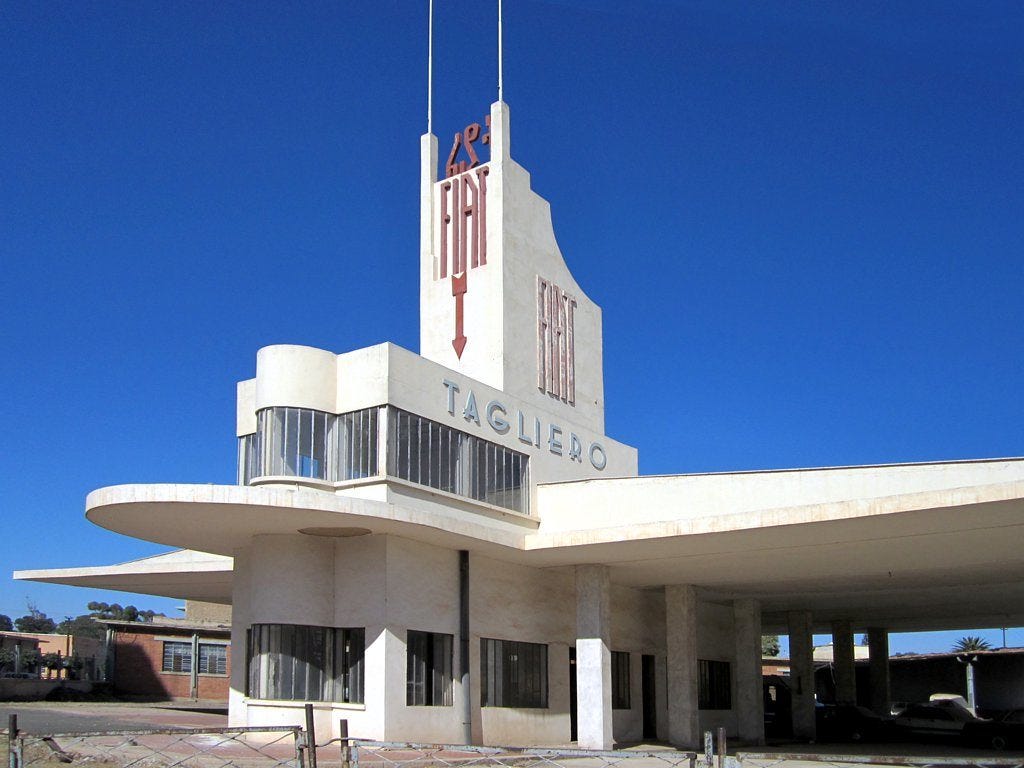
Gdynia’s own account of itself is careful on this point. It notes, accurately, that the city was not built on land seized from anyone: the Kashubian families, an indigenous Slavic people native to this stretch of Baltic coast, who had farmed here before 1926, sold their fields freely and became, in the nomination’s own words, full participants in what followed. This is true, and worth saying. What the nomination does not mention are the “favelas” out of the white city centre. Every city’s official story chooses its own silences.
1939-1945
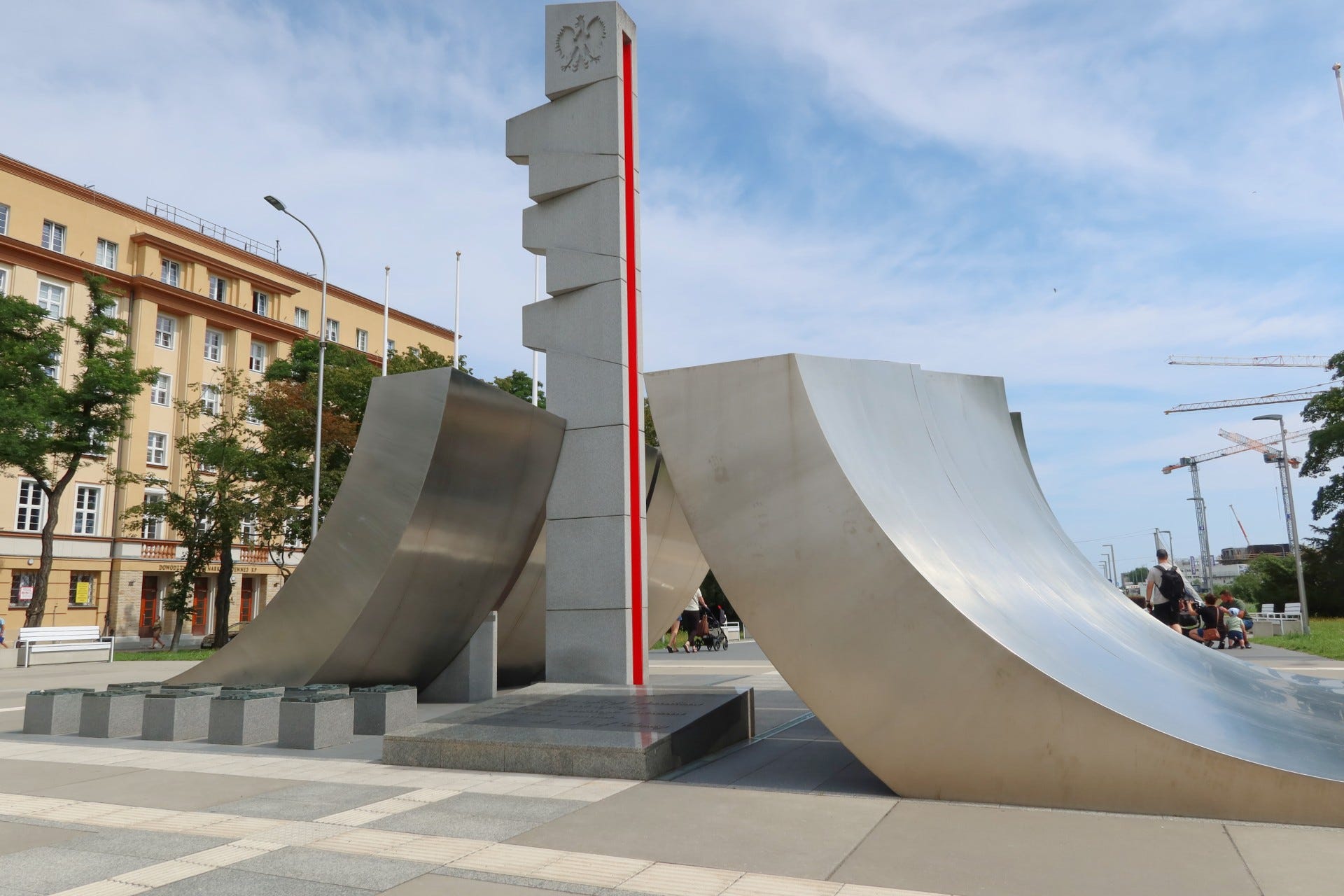
The war began on the first of September, 1939, forty kilometres from here, on a narrow spit of land called Westerplatte, where a Polish garrison of barely two hundred men held out for seven days against a German battleship, buying the rest of the country time it desperately needed. It is the most famous first shot in Polish and European memory.
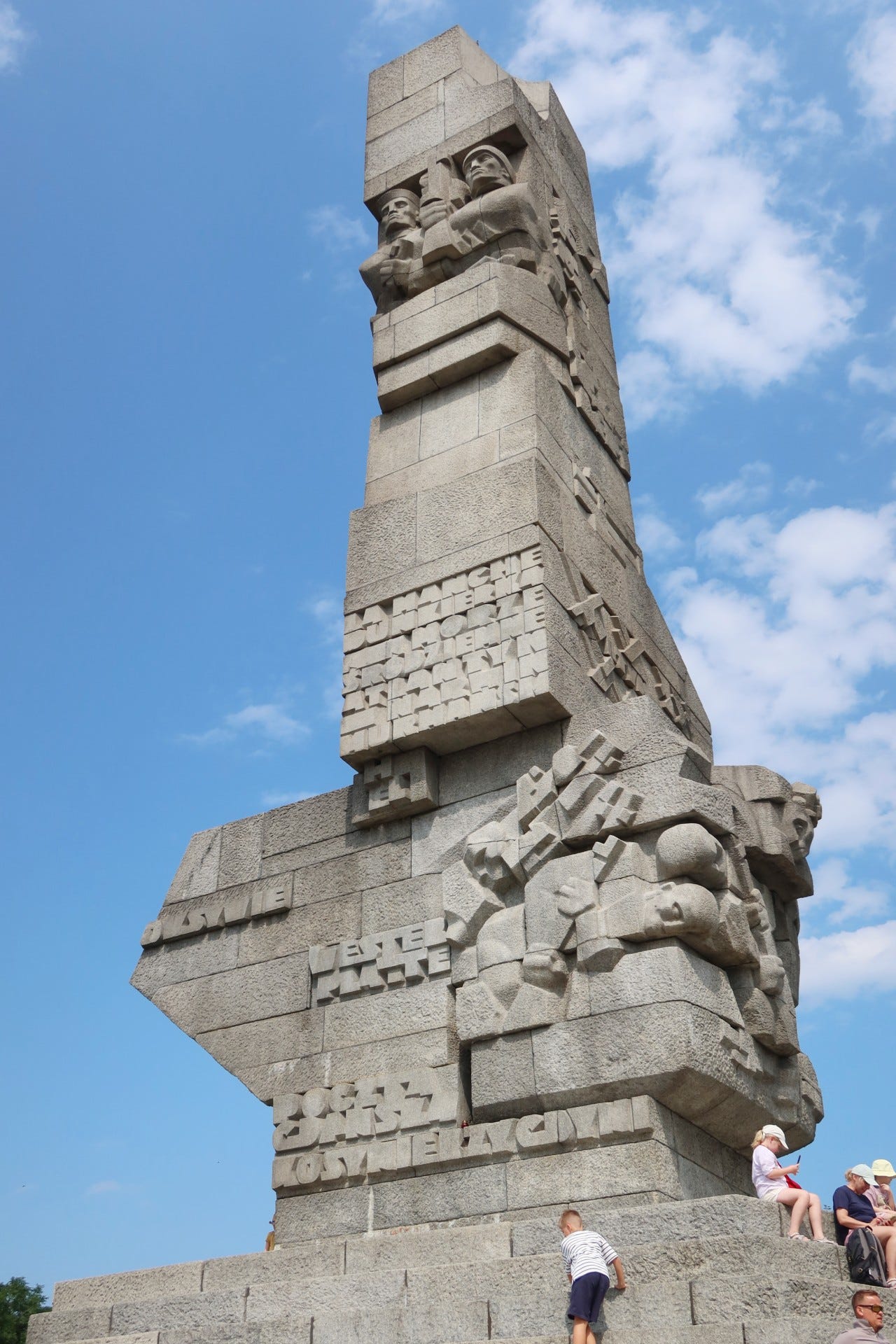
Gdynia fell on the fourteenth of September. The survivors retreated to Kępa Oksywska, wooded heights northeast of the city, where they held out five days longer. Among the ships lost defending these waters was the Wicher, the young navy’s proud first destroyer, sunk by German dive bombers at Hel on the third of September, two days after the war began.
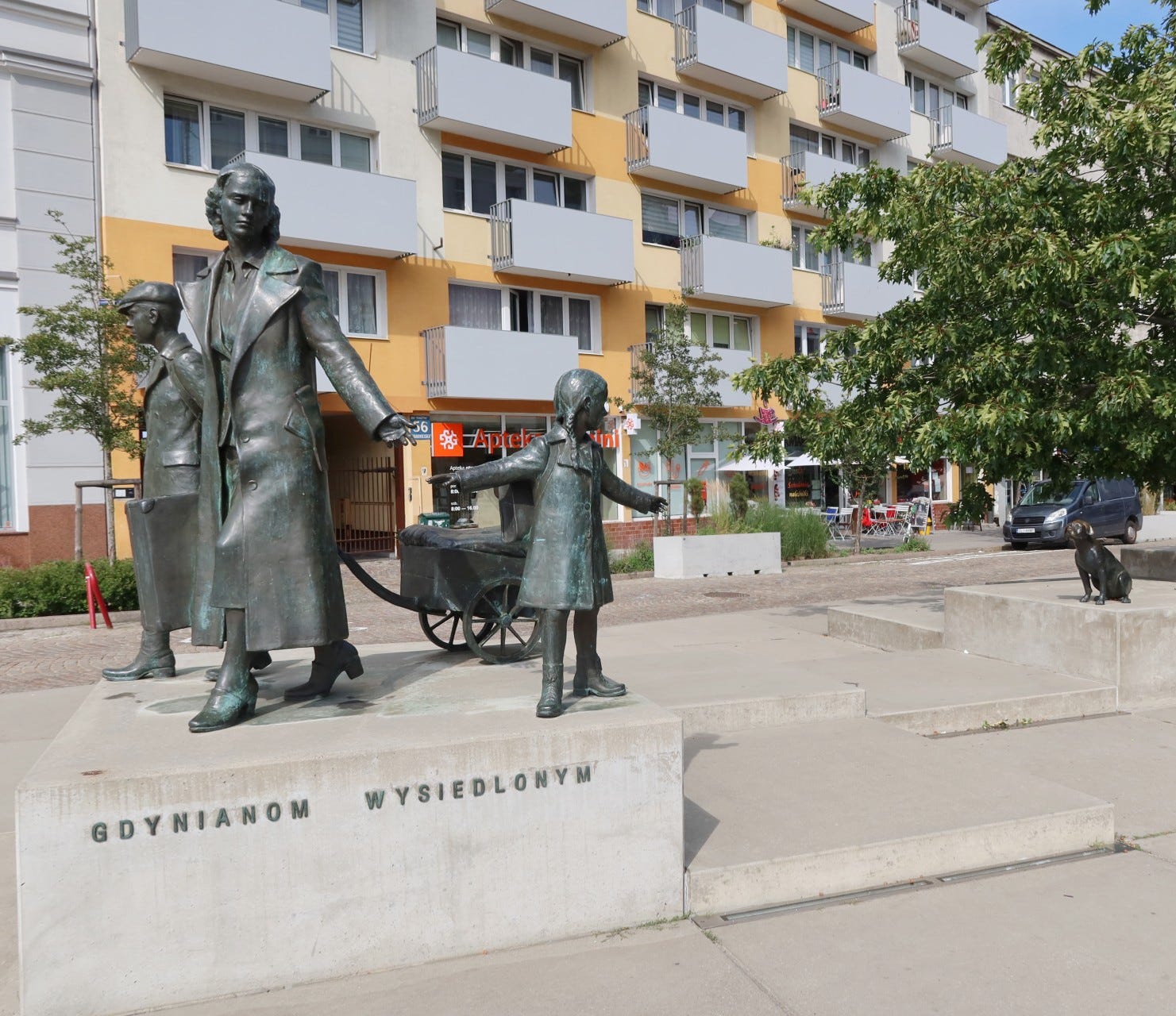
The Germans renamed the city Gotenhafen and began erasing what was left of it. Starting in October 1939, Polish families were given as little as minutes, sometimes a few hours, to leave their homes, carrying only what fit in a single bag, roughly fifteen kilograms, everything else left behind for the ethnic German settlers, the co-called Volksdeutsche, being resettled in from the Baltic states to take their place. Around fifty thousand people were expelled from Gdynia in that first wave alone.
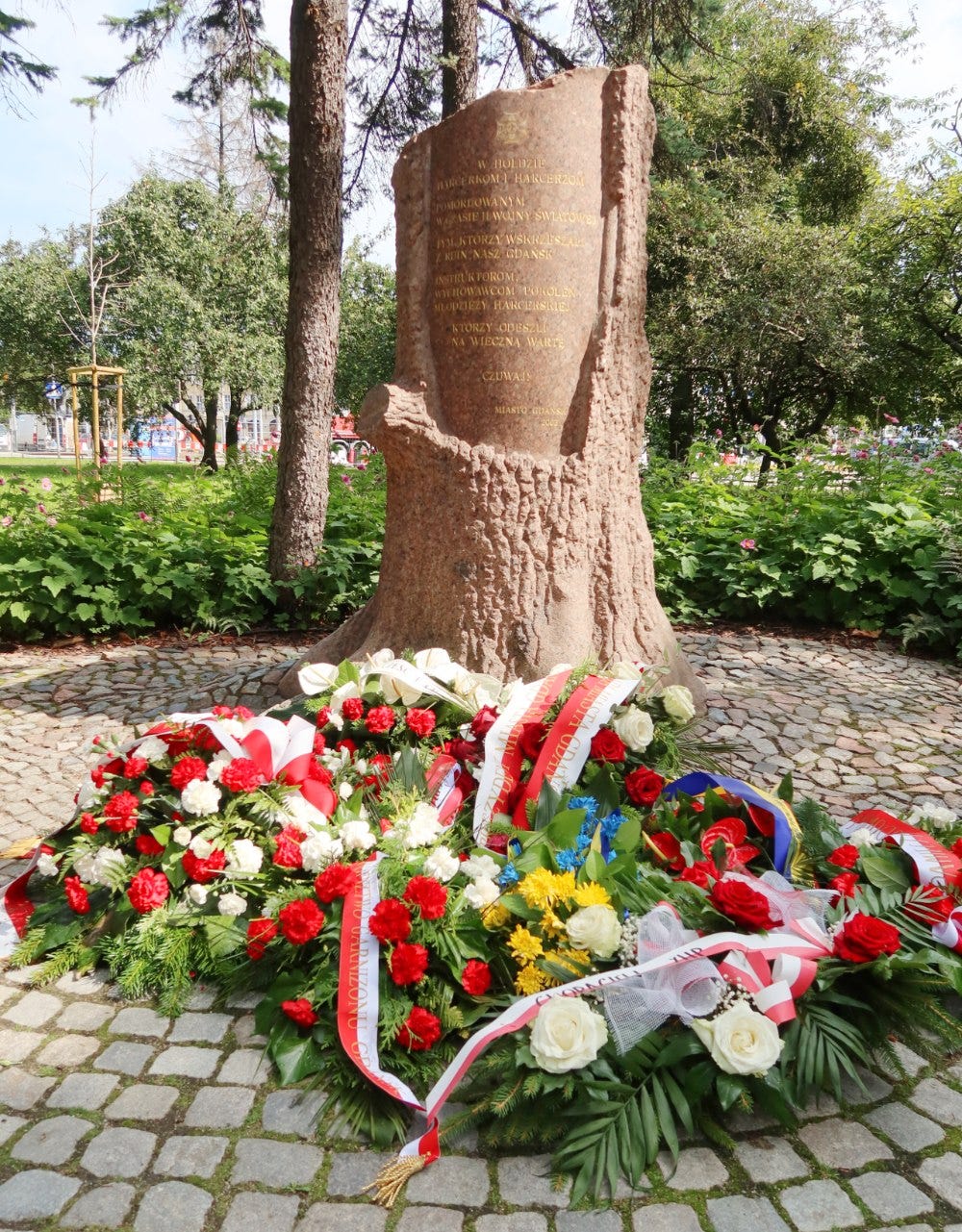
Not everyone accepted to leave. Gdynia’s scouts formed part of the Szare Szeregi, the Grey Ranks, a clandestine resistance network that ran couriers, printed underground newspapers, and later fought in the Warsaw Uprising. Others joined the Home Army, the Armia Krajowa, whose anchor symbol, Kotwica, P and W overlapping for Polska Walcząca, Poland Fighting, still marks memorials across the city.
Gotenhafen, meanwhile, became one of the Kriegsmarine’s most valuable ports, safe from Allied bombing until 1944, a base for the submarine fleet that hunted convoys across the Atlantic. It stayed safe until the war came home to find it.
On the thirtieth of January, 1945, with the Red Army closing in from the east, a former cruise liner called the Wilhelm Gustloff left this same port crammed with German refugees, wounded soldiers, and U-boat trainees, bound west. A Soviet submarine sank her within the hour. Somewhere between nine and nine and a half thousand people died, more than the Titanic and the Lusitania combined: the deadliest maritime disaster in recorded history, and one that, for decades, neither side had much interest in remembering.1
Post-war
The port did not survive the war. In March 1945, retreating German forces scuttled the battleship Gneisenau across the harbour entrance to block it, and sabotaged what else they could not carry. The modernist centre, instead, came through largely intact: it was the machinery of the port, not its architecture, that the war destroyed.
Gdynia became Polish again in 1945, repopulated in part by refugees from the areas of Poland annexed by the USSR.
By October 1949, ships of the Israeli line Zim Cargo began calling at Gdynia on a monthly run. The port that had once sent Jewish emigrants toward Palestine now received cargo from the state they had built.
Today, tomorrow
On the twenty-seventh of July, 2026, in Busan, South Korea, the World Heritage Committee added the Modernist Centre of Gdynia to the UNESCO World Heritage List. UNESCO’s own comparison, drawn up as part of the nomination, placed Gdynia alongside Asmara, Ljubljana, Kaunas, Tel Aviv, Ivrea, Berlin, Mumbai and Shanghai.
Just over two weeks later, on the thirteenth of August, a new ship slid into the water at the same port. Her name was Wicher.
This new Wicher, the first of three new frigates, was built here, in Gdynia’s own shipyard, more than a hundred and forty metres of steel based on a British design. Where the first Wicher was a small, proud gesture of a country hoping to be taken seriously, this one is a statement.
Poland now spends more of its GDP on defence than any other country in NATO: around four and a half percent this year, budgeted to rise past four and three-quarters next year, against roughly three percent for the United States, two and a half for Britain, and close to two for France and Germany. The government’s stated target is five percent. The army is being expanded toward half a million men and women under arms, active and reserve combined.
I live in Berlin, and I have seen how differently the two capitals live this moment. In Germany, the mood around rearmament is heavy, reluctant, argued over in a language still uncomfortable with its own army. In Poland, it doesn’t feel like that. It feels like muscle memory: a country fought over as spoils by two empires over the last three centuries - and determined not to become spoil again.
This summer, near the Polish border, I watched military helicopters cross overhead in formation, heading east toward the Suwałki Gap, the narrow strip of Polish and Lithuanian territory that separates Kaliningrad from Belarus, the single most discussed vulnerability on NATO’s eastern map. Life goes on around it, ordinary and even cheerful. But everyone here knows exactly what that strip of land means.
A century ago, Poland built Gdynia to prove it could stand between Germany and Russia without being erased by either. A century later, it is doing something similar, but on a larger scale: as the bastion protecting not only itself, but a whole European Union of which it has been a proud member since 2004, and, economically, an unrivalled success story. Proud, also, of its modernism.
Günter Grass gave the story its reckoning in 2002, in a short novel called Crabwalk. His narrator, born the night of the sinking, tells the story alongside that of his own son, drawn by his grandmother into a neo-Nazi website built in Wilhelm Gustloff's memory.
Thank you for so much detailed information and so well written. I am very grateful for your commitment to making the architectural links and the historical background so clearly stated.
Thank you - there’s so much here I did not know. I visited Gdansk and Sopot this year. Now I’m sorry I didn’t make it to Gdynia.